How KONI Works
The same five steps, over one real week. You watch. KONI holds the curriculum.
Observe
Watch what catches their attention: what they repeat, what frustrates them, what brings deep focus.
Example:
"Emma spent 20 minutes pouring water from one container to another without stopping."

Connect
KONI places what you noticed in context, against previous work, interests and the Montessori sequence — as an emerging skill, an interest, a moment of independence, or something they may need more time with.
Example:
""Emma showed strong interest in water activities. Demonstrated careful concentration and precise movements.""
Plan
Lessons from the sequence your child is standing in, built from what you noticed rather than from a birthday.
Example:
"KONI suggests: "Flower Arranging" (builds on water interest, adds care of environment)"
Decide & present
KONI proposes. You decide. You know the room, the morning and the mood — move it, skip it, repeat it, or choose something else. When you’re ready, open the lesson for step-by-step guidance on what to prepare, how to present it, and what to watch for.
Example:
"Tuesday morning: Set up flower arranging station before Emma wakes up."
Record & reflect
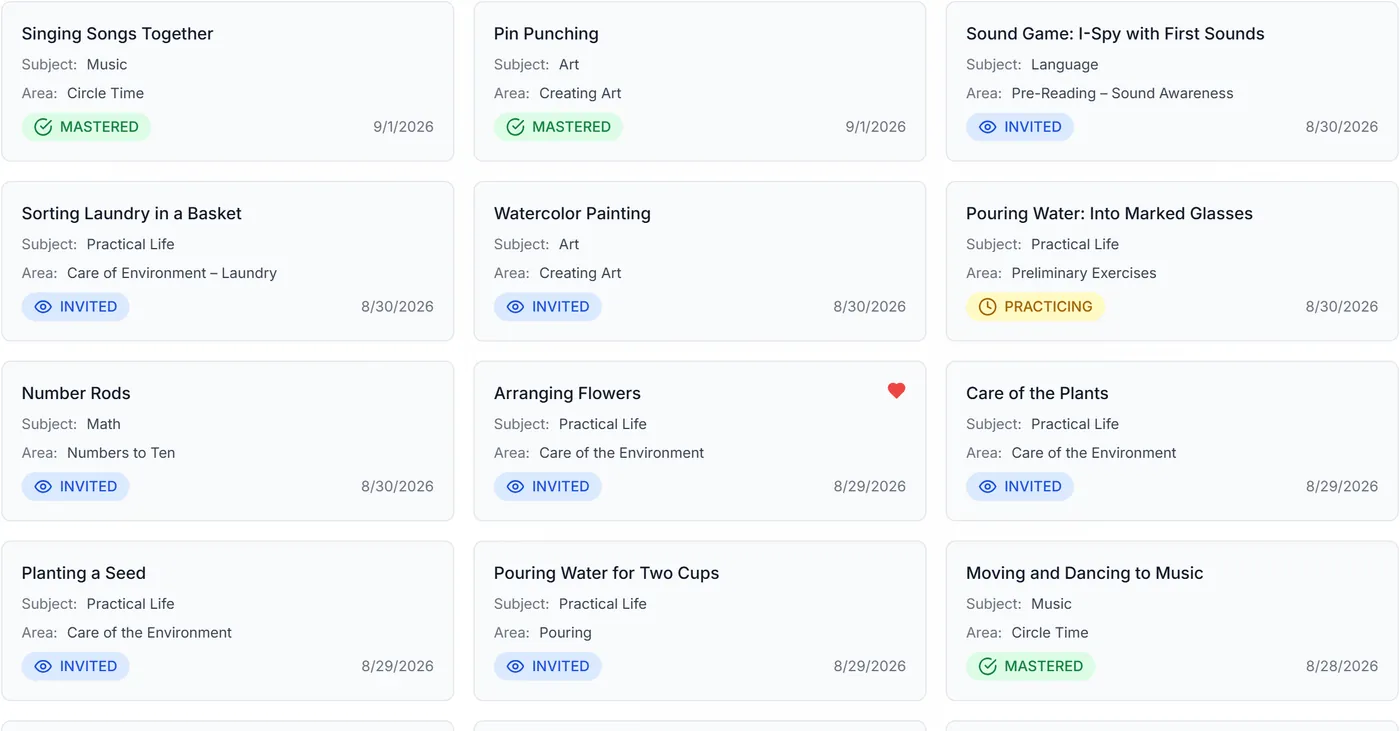
Offered, practiced, mastered. What you record shapes what KONI suggests next.
Example:
"Emma worked with flowers for 35 minutes. Now showing interest in plant care and gardening."
Monday morning, already prepared.
Not a feed of ideas. A sequence, a prepared week, and a reason for every lesson in it.
Every lesson, step by step
One lesson at a time: sequence, materials, presentation steps and purpose, made practical for home. Printables for many of them.

Montessori is not the wooden toys.
One materials list for the week, grouped, tickable and printable. When the exact material isn’t practical, KONI can suggest a household alternative that keeps the purpose of the work.

Learn Montessori while you use it
Five-minute guides on sensitive periods, observation, a small prepared space, repetition, readiness, and what to do when a lesson falls apart.

Every child, their own place
Tell KONI about the supports that help your child learn best, from sensory to language needs, and it favours fitting adaptations while keeping the lesson’s purpose intact.
Why it works this way
Observation-Led
Decisions come from what you saw this morning, not from a chart of what a four-year-old does next.
Matched to readiness
Lessons follow the work your child has already done, not their age in months.
Yours to change
No rigid schedule. The week bends to your family, not the other way round.
What a Week with KONI Looks Like
One week with Emma, four years old. About fifteen minutes of planning, spread across the week.
Hover over each day to explore • Click checkmark to mark complete
Monday
Emma pours water between two jugs for twenty minutes, twice over. You write one line about it while she naps.
Tuesday
KONI reads the pouring as care and concentration, and suggests Flower Arranging. You set the tray out before she wakes.
Wednesday
Emma works with the flowers for thirty-five minutes. You mark it practiced, and note that she refilled the jug herself.
Thursday
The refilling points toward plant care. KONI offers Watering a Plant next, with a five-minute Guide Hub read on presenting it.
Friday
You look back at the week. The thread from pouring to flowers to plants is there, and next week starts from it.
Emma’s week, in planning time
This week it came to about fifteen minutes of planning. Some weeks are shorter, some longer. The rest is living and learning with your child.
Your child never opens KONI. There are no tests, no grades and no comparison to another child, and nothing here decides anything for you.
Where technology belongs, and where it stopsSee it with your own child.
We’re inviting our first families. See how KONI fits into your family’s rhythm.